
Thailand has launched a new visa scheme designed to attract digital nomads, remote workers, and freelancers, offering them the opportunity to live and work in the country for extended periods.
The Destination Thailand Visa (DTV), which became available on July 15, 2024, aims to bolster Thailand’s economy by enticing a growing segment of the global workforce to call the Southeast Asian nation their temporary home.
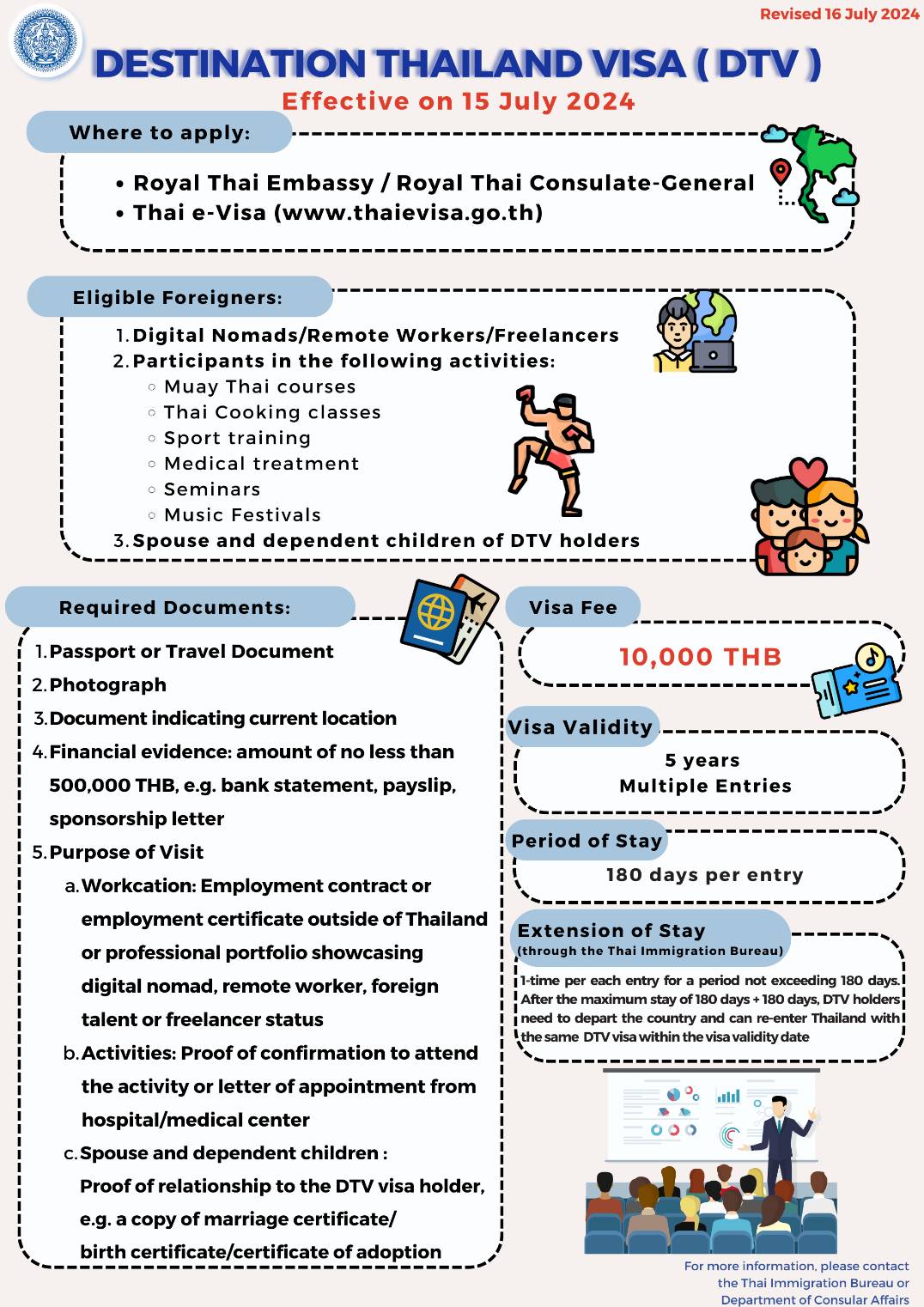
The DTV visa is valid for five years, allowing holders to stay in Thailand for up to 180 days per entry. Those who wish to extend their stay can simply exit and re-enter the country, restarting the 180-day period.
 Subscribe to the Hua Hin Today newsletter for the latest news, information and events from Hua Hin delivered to your inbox

 SUBSCRIBE
As of Aug 26, Hua Hin Today understands that approximately 1,200 DTVs have been issued since its launch in July.
Visa application process and requirements
To apply for the DTV, applicants must be at least 20 years old and hail from one of the 93 eligible countries.
Applications can be submitted online or through a Thai embassy or consulate, but not at immigration offices within Thailand.
The required documentation includes a valid passport, proof of financial stability, evidence of salary slips from the last six months, a foreign employment contract, the employer’s business licence, and a professional portfolio.
For those looking to obtain the visa through Thailand’s “soft power” activities—such as Muay Thai boxing, Thai cooking courses, or short-term education programs—additional requirements apply. Applicants must provide a letter of acceptance from the sponsoring company, which must be registered with the Department of Education in Thailand to prevent fraud.
The cost of the DTV visa is 10,000 Thai baht, and applicants must demonstrate proof of funds equating to around 500,000 baht . However, the fee may vary depending on the consulate. For example, applicants in the United States and the United Kingdom face higher charges due to additional service surcharges imposed by the embassies.
The devil is in the details
As with all things immigration or visa related to Thailand, the devil is always in the details.
While many embassies and consulates have begun accepting DTV applications, the process is not without its challenges – namely differing or conflicting information.
Some, like those in Laos and Sri Lanka, have yet to provide any information on the visa (at the time of writing), while others, including the Thai embassy in Cambodia, are awaiting the implementation of new online technology before processing applications.
The Thai embassy in Kuala Lumpur has issued one of the most detailed checklists for DTV applicants, requiring additional documentation such as a Thai condominium rental agreement or a property lease valid for at least six months. Digital nomads must also provide an authenticated copy of their employment contract or business licence, and bank statements must be at least three months old, with a minimum balance of 500,000 baht.
Moreover, some consulates have stipulated that proof of income over the past six months is required, rather than merely showing a current bank balance. The variation in requirements has led to confusion among applicants, highlighting the need for potential applicants to carefully review the specific criteria outlined by the embassy or consulate in their home country.
Impact on Thailand’s economy and tourism
The introduction of the DTV comes at a time when Thailand is seeking to revitalise its tourism sector, which was severely impacted by the COVID-19 pandemic. In 2019, tourism accounted for 11.5% of the country’s GDP, with a record-breaking 39 million visitors. As of mid-2024, Thailand welcomed 21 million visitors, and officials are optimistic about reaching 36 million by the end of the year.
The rise of digital nomadism, driven by technological advancements and the shift to remote work during the pandemic, has created a new category of long-stay tourists. While Chiang Mai and Koh Phanghan are often the examples given when discussing locations for digital nomads in Thailand, Hua Hin has seen a significant surge in visitors using the town as a base to work remotely.
By offering the DTV, Thailand hopes to attract this group, who typically have higher spending power and can contribute significantly to the local economy.
However, the scheme has not been without its critics. Some within Thailand have expressed concerns that the ease of obtaining the DTV could lead to an influx of foreign workers, potentially driving up rent prices and contributing to “overtourism.” Additionally, applicants with a history of overstaying their visas may find their eligibility for the DTV compromised, as some consulates have flagged this as a potential issue.
Looking ahead
As Thailand continues to navigate its post-pandemic recovery, the Destination Thailand Visa represents a significant step towards attracting a new wave of long-stay tourists who contribute to the economy while enjoying the country’s diverse culture and landscapes.
Potential applicants are advised to thoroughly research the specific requirements set by the Thai embassy or consulate in their home country to ensure a smooth application process. With the DTV now in effect, Thailand is poised to become an even more attractive destination for digital nomads and remote workers worldwide.
For further details on the DTV and application procedures, applicants should consult the relevant Thai embassy or consulate or visit the official e-Visa website.
It’s never been easier to visit Thailand
The introduction of the DTV visa aligns with several other significant changes in Thailand’s visa policies. Alongside the DTV, the country has expanded its visa-free entry program from 57 to 93 countries, now including populous nations like India and China.
Visitors from these countries can now enter Thailand with a 60-day entry stamp, which can be extended for an additional 30 days at an immigration office. This extension provides greater flexibility for tourists and those engaging in short-term work, which is allowed for up to 15 days with prior permission from a labour office or at the airport.
For travellers from countries not on the visa exemption list, Thailand has also increased the number of nations eligible for visa-on-arrival from 19 to 31. Although this visa is valid for only 15 days and costs 2,000 baht, it offers a new entry option for a wider range of visitors.
In addition, Thailand has made it easier for the 40,000 foreign students at its colleges and universities to stay in the country after graduation. Graduates are now allowed to remain for one year to seek employment in their field of study, marking a significant change from the previous requirement to leave immediately after finishing their courses.
These changes to Thailand’s visa policies have made it easier than ever for foreigners to visit, study, work, and live in the country.
Subscribe to the Hua Hin Today newsletter for the latest news, information and events from Hua Hin delivered to your inbox SUBSCRIBE